



 Serving
A non-surgical way to widen a narrow jaw
MARPEA narrow upper jaw doesn’t always respond to a standard expander, especially once a patient is past childhood. MARPE anchors directly to the palate bone with small implants, making controlled expansion possible without surgery, for patients whose growth has moved beyond what a conventional expander can treat. |

|
|
For teens nearing maturity
Roughly ages 13–16Once a standard expander stops being enough, as the palate begins to fuse. |
For adults
Fully fused palateA non-surgical alternative to surgically-assisted expansion (SARPE). |
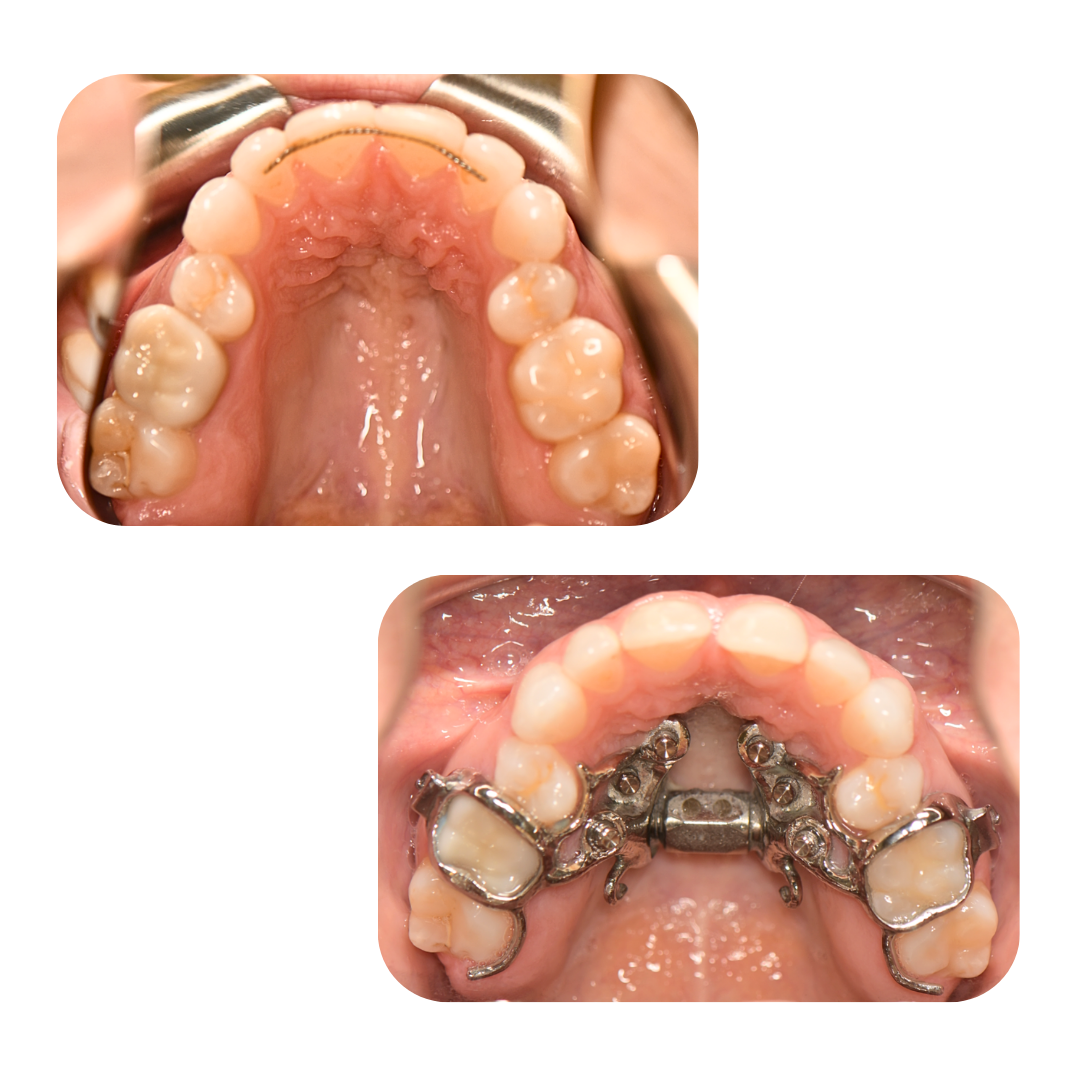
MARPE for teens nearing skeletal maturity
When a standard expander isn’t enough anymore
Younger children with a fully open midpalatal suture usually respond well to a conventional palatal expander. But as kids move through early adolescence, that suture begins to interdigitate and fuse, typically somewhere between ages 12 and 15, and conventional expanders become less predictable, sometimes tipping teeth instead of truly widening the jaw. MARPE bridges this window. By anchoring to the palate bone itself with small implants, it can achieve real skeletal expansion even as the suture is mid-fusion, without resorting to surgery.
Worth a conversation if your teen has…
- A narrow or high-arched palate that didn’t fully resolve with an earlier expander
- Crowding without enough room for permanent or wisdom teeth
- Ongoing nasal obstruction or mouth breathing
- A previous standard expander with limited or uneven results

|
MARPE for adults
Widening the upper jaw without surgeryOnce the midpalatal suture has fully fused, usually by the late teens or twenties, a conventional expander can’t move the bone at all, and the surgical alternative, SARPE, comes with anesthesia, a hospital visit, and recovery time most adults would rather avoid. MARPE offers a non-surgical middle path: small implants anchor the expander directly to mature bone, so the force goes into the jaw itself instead of the teeth. |
Worth a conversation if you have…
- A persistent narrow or high-arched palate
- Crowding or impacted teeth that need more arch space
- Ongoing nasal obstruction, snoring, or other airway-related risk factors
- A wish to avoid the surgery, anesthesia, and recovery time of SARPE
|
For teens & adults
How MARPE works
|
1
Consultation & imagingA scan or CBCT shows us exactly how far your suture has fused. |
2
Custom designYour expander is sized to your palate, with guides for 4 mini-implants. |
3
In-office placementAbout 20–30 minutes under local anesthesia, no hospital visit. |
4
Daily activationYou turn the screw daily for 4–6 weeks; the expander stays in 4–6 months while new bone forms. |
Why consider it
Why patients choose MARPE
|
20–30
minutes for in-office placement
|
4–6
months the expander stays in place
|
|
|
||||
|
|
Common questions
Patients’ questions
Does MARPE hurt?
Most patients feel mild discomfort around placement and during the early days of activation, manageable with an over-the-counter pain reliever.
Will there be a gap between my front teeth?
Yes. Expansion splits the suture and opens a temporary gap, which orthodontic treatment closes afterward as part of your overall plan.
Is MARPE different for teens versus adults?
The mechanism is the same, mini-implants anchored to the palate bone, but candidacy, appliance design, and treatment length depend on how far the suture has fused, which we assess with imaging.
Is MARPE the same as SARPE?
No. SARPE is a surgical procedure performed under general anesthesia. MARPE achieves expansion without surgery for patients who are good candidates.
Curious if MARPE is right for you?
Whether it’s for you or your teen, we’ll start with imaging and an honest answer.

Two Convenient Locations To Serve You!
Complete Orthodontic care in Irving and Dallas
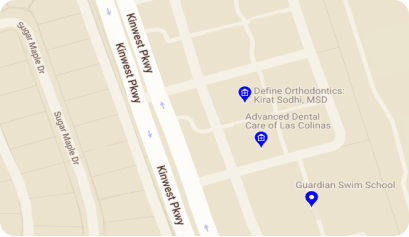
Las Colinas
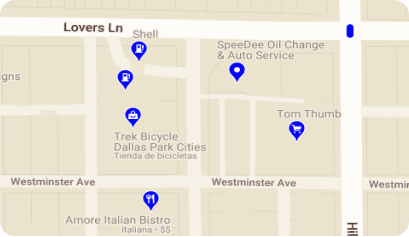
Park Cities

Ready to Define Your Smile?
Start your journey today! We're here to guide you every step of the way.