



 Serving
Breathing, alignment & growth are connected
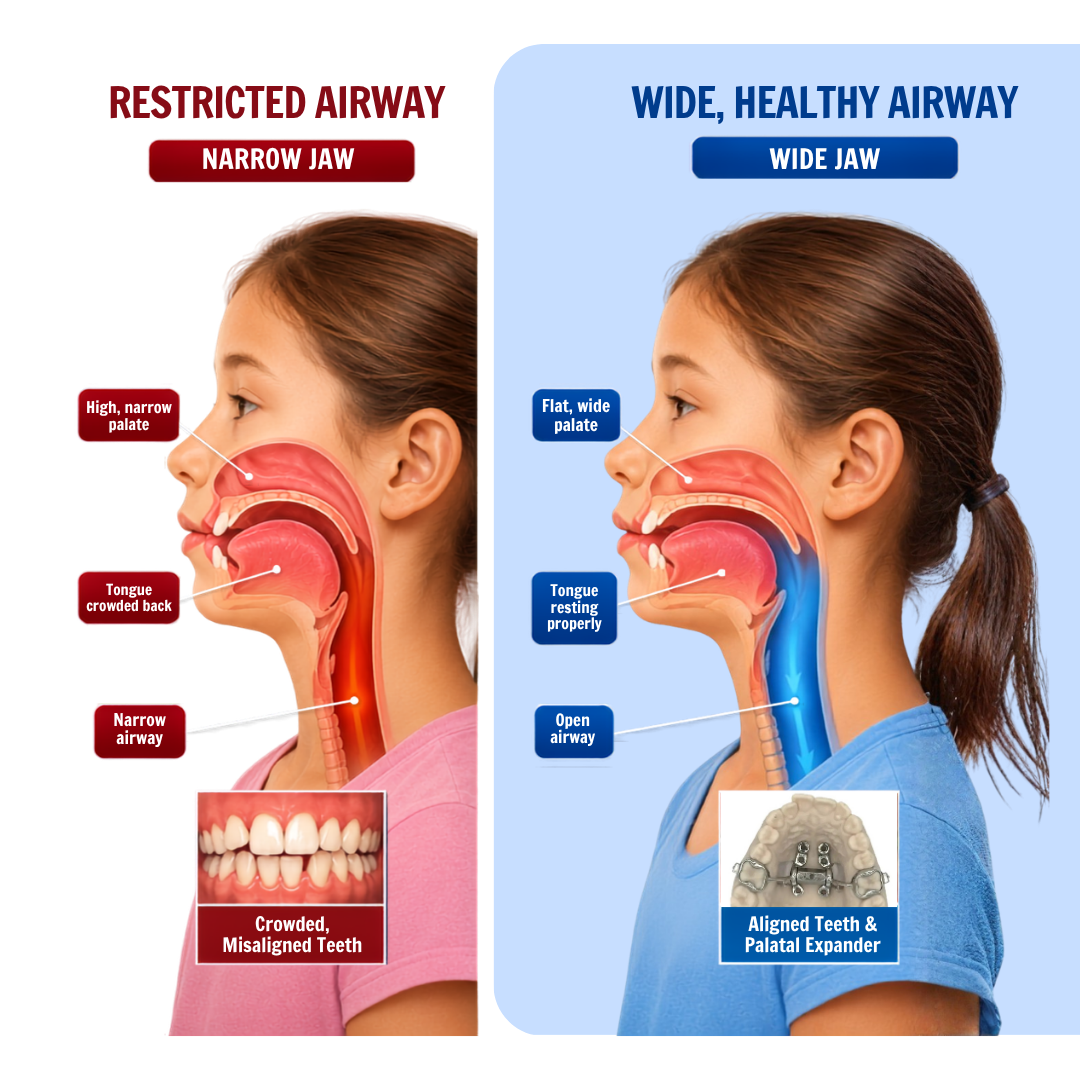
Airway conscious orthodonticsAn obstructed airway doesn’t just affect breathing. It can shape how the jaw and face develop, and how well you sleep. Because an airway looks very different in a fully grown adult than in a child who’s still developing, we approach each one differently. |
|
For Adults
Adult airway concerns
Snoring, daytime fatigue, and how a narrow bite relates to sleep apnea risk factors.
For Children
Child airway concerns
Mouth breathing, restless sleep, and the developmental signs parents often miss.
Airway care for adults
When a narrow bite shows up as sleep apneaAn airway problem in a fully grown adult often looks different than it does in a child. Once the jaw has finished developing, a constricted maxilla can’t widen on its own, and that narrowing is linked to several risk factors seen in obstructive sleep apnea (OSA): increased nasal resistance, altered tongue posture, and a narrowed airway behind the throat. Dr. Sodhi’s airway-conscious evaluation looks at where your bite and jaw structure may be contributing to those risk factors. |

|
Signs worth a conversation
- Snoring, or a partner noticing pauses in your breathing at night
- Waking up gasping or choking
- Morning headaches or a dry mouth on waking
- Daytime fatigue despite a full night’s sleep
- A narrow or high-arched palate noted during a dental exam
|
For adults whose growth plates have already fused, traditional palatal expansion isn’t an option. That’s why we offer MARPE, a Microimplant-Assisted Rapid Palatal Expander that anchors directly to the palate bone, allowing us to widen the upper jaw and improve airflow even after the midpalatal suture has closed. It’s one piece of a broader, multidisciplinary approach to airway health.
Airway care for children
Catching breathing problems while the bite is still growingNasal breathing plays a big role in how a child’s face and jaw develop. When a child consistently breathes through the mouth, whether from allergies, enlarged tonsils, or a narrow airway, it can affect facial growth, dental crowding, and tongue posture. It can also disrupt the deep sleep children need, and those disrupted nights often show up the next day as everyday childhood issues rather than obvious sleep complaints. |
Nighttime signs
|
Daytime signs
|
Because daytime signs like trouble focusing or irritability can look a lot like attention or behavioral concerns, some children are evaluated for ADHD before anyone considers their airway. Pediatric research has found a meaningful overlap between sleep-disordered breathing and ADHD-like symptoms in children, which is part of why researchers increasingly recommend screening for mouth breathing and airway issues before settling on a behavioral diagnosis alone.
|
Around age 7, while the midpalatal suture is still open, a child’s upper jaw responds well to gentle, gradual expansion. If we find a narrow arch, high palate, or signs of habitual mouth breathing, an early appliance can widen the airway while guiding healthy jaw and tooth development, often as part of our two-phase treatment approach.
Common questions
Patients’ questions
Orthodontic treatment, like MARPE, can address physical risk factors such as a narrow maxilla. A sleep physician must still diagnose OSA through a sleep study, and we coordinate care alongside that evaluation.
Occasional snoring is common, but persistent snoring, mouth breathing, or restless sleep is worth a conversation, especially alongside changes in daytime focus or behavior.
Around age 7, similar to our general orthodontic screening recommendation, since the palate is still responsive to expansion before the midpalatal suture fuses.
Not always, but it’s worth monitoring. Persistent mouth breathing is one of several signs we look at together, alongside sleep quality, facial growth, and daytime behavior.
Ready to talk about your airway?
Whether it’s your sleep or your child’s, we’re here to help you find the right next step.

Two Convenient Locations To Serve You!
Complete Orthodontic care in Irving and Dallas
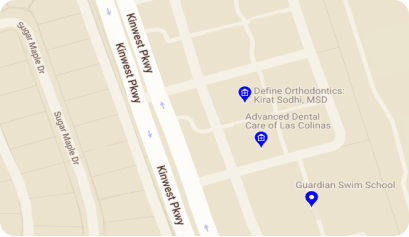
Las Colinas
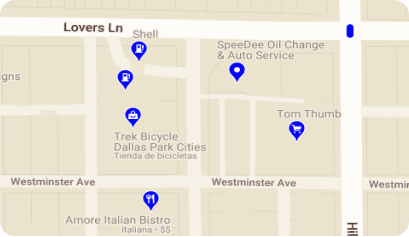
Park Cities

Ready to Define Your Smile?
Start your journey today! We're here to guide you every step of the way.